Artur
Artur is one of the two assistants assigned to K., the land surveyor, by the castle authorities. He is introduced as a young man of medium height, very lean, with a dark brown complexion and a black goatee beard, nearly identical to his companion Jeremias. Artur's role is defined by his service to K., which he performs with a mixture of outward obedience and covert resistance, ultimately leaving K.'s service to complain to the castle about his treatment. His character embodies the ambiguous, almost interchangeable nature of the castle's servants and the bureaucratic absurdity that K. confronts.
Identity and Introduction
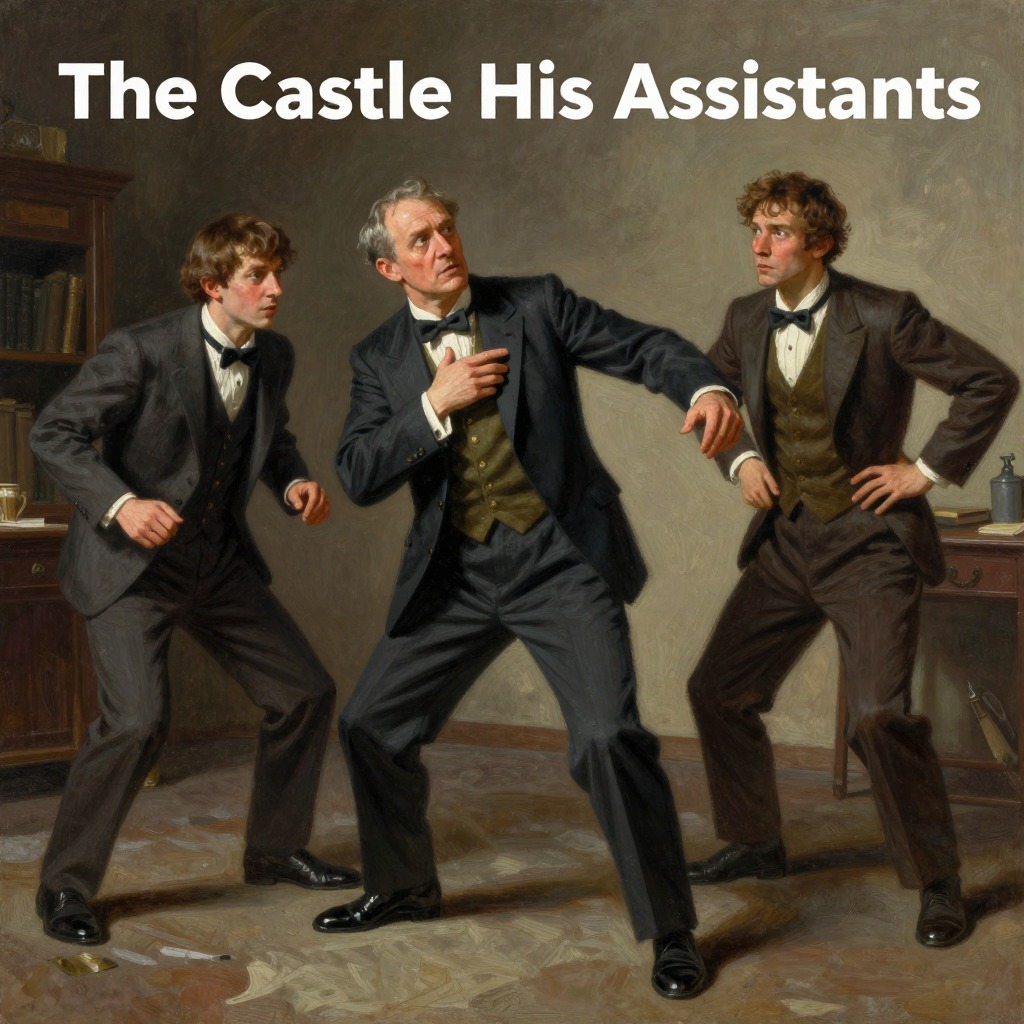
Artur first appears on the road from the castle, walking with remarkable speed alongside his companion Jeremias, both of them swinging their long legs in time. They are described as being of medium height, very lean, with close-fitting clothes and faces that are very much alike, their dark brown complexions setting off their very black goatee beards. When K. first encounters them, he is struck by their similarity, noting that the only difference between them is their names, and apart from that they are "as like as two snakes." This indistinguishability becomes a central feature of their identity, as K. decides to treat them as a single man, calling them both Artur, a decision that the assistants openly dislike but are forced to accept.
Life and Plot Trajectory
Artur and Jeremias are introduced to K. as his assistants, claiming to be his old assistants who were coming on after him. They arrive at the Bridge Inn, where K. is staying, and are confirmed by the landlord as the assistants. K. is immediately suspicious of them, noting that they have no surveying instruments and know nothing about land surveying. Despite this, he accepts them into his service, and they follow him to the Castle Inn, where they witness K.'s encounter with Frieda. Their presence becomes a constant source of irritation for K., as they observe him attentively, play childish games, and seem to be more loyal to Frieda than to him. K. eventually dismisses them, but they refuse to leave, clinging to the fence of the school garden and pleading to be taken back. Artur, described as a sensitive soul, is particularly affected by K.'s harsh treatment, and after being struck by K. in the night, he flees to the castle to complain.
Key Actions and Objectives
Artur's primary objective, as revealed by Jeremias, is to carry out the orders given to him by Galater, who was deputizing for Klamm at the time. Galater instructed the assistants to cheer K. up, telling them that K. takes everything very hard and that his arrival in the village is a great event to him. Artur and Jeremias are to show K. that this is nothing at all. This mission explains their seemingly childish and irritating behavior, as they are attempting to lighten K.'s mood through jokes and teasing. However, their methods are crude and ultimately counterproductive, leading to K.'s growing frustration and their eventual dismissal. Artur's decision to go to the castle to complain about K.'s treatment is a direct consequence of his failure to carry out this task, as he feels that K. was too harsh with them.
Relationships and Conflict
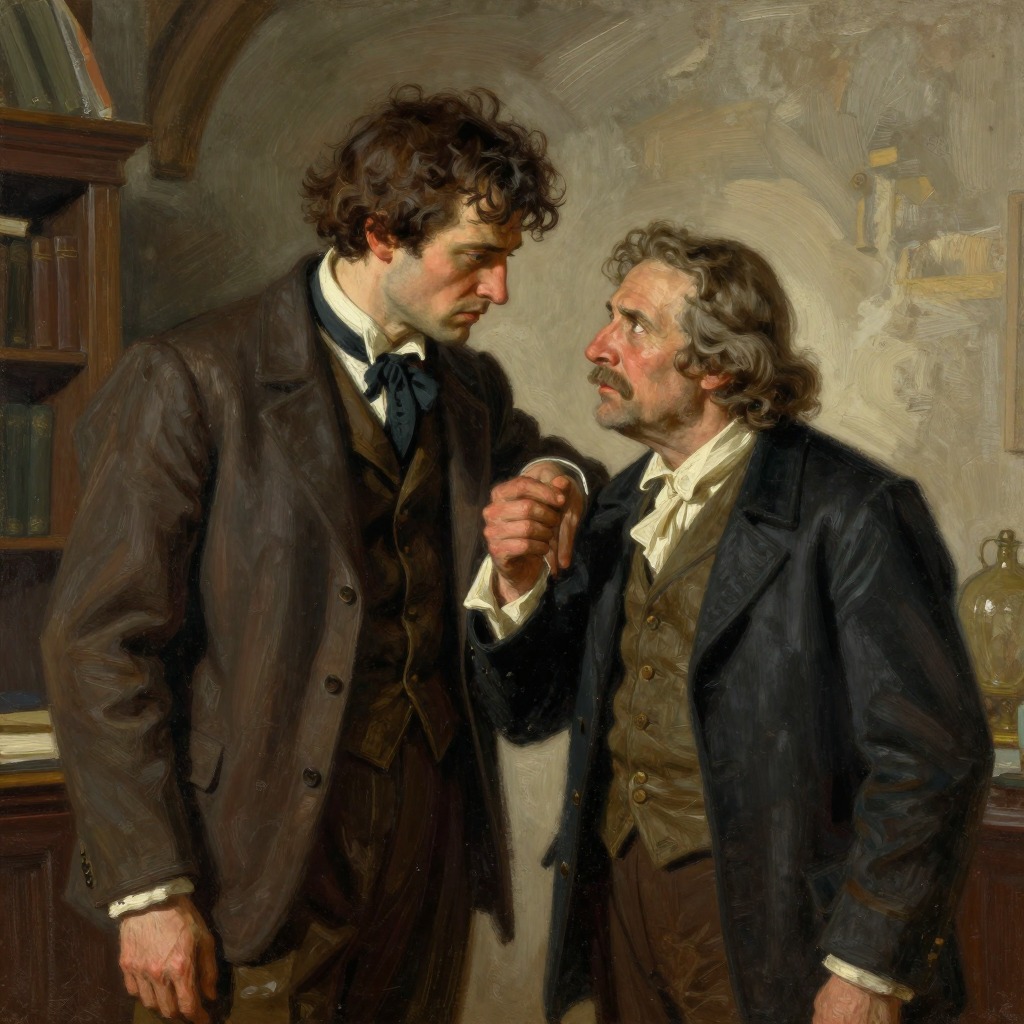
Artur's relationship with K. is marked by conflict and mutual misunderstanding. K. sees the assistants as a nuisance, constantly watching him and interfering in his affairs, while Artur and Jeremias see themselves as dutiful servants carrying out orders. The conflict escalates when K. dismisses them, and they refuse to accept the dismissal, leading to a standoff at the school. Artur's sensitivity is highlighted in this conflict, as Jeremias notes that Artur is a "sensitive soul" who feels pain for days after so much as a cross word. This sensitivity is contrasted with K.'s harshness, which ultimately drives Artur away. The relationship between Artur and Jeremias is also notable, as they are nearly identical and act as a unit, with Artur's departure leaving Jeremias to continue alone.
Change and Ending
Artur's story ends with his departure from K.'s service and his journey to the castle to complain. This action is reported by Jeremias, who tells K. that Artur has gone back to the castle to complain of him. Artur's departure marks a turning point in K.'s relationship with the assistants, as Jeremias remains behind and eventually takes Frieda away from K. Artur's fate after this point is unknown, but his decision to complain to the castle reflects the assistants' belief that they have been wronged by K.'s treatment. His departure also highlights the transient and replaceable nature of the castle's servants, as K. is left to deal with Jeremias alone.
Narrative Role and Evaluation
Artur serves as a representative of the castle's bureaucratic machinery, a figure who is both a tool of the authorities and a source of disruption for K. His near-identical appearance to Jeremias underscores the theme of interchangeability and the dehumanizing nature of the castle's service. Artur's role in the narrative is to test K.'s patience and to illustrate the absurdity of the castle's methods, as his mission to "cheer up" K. is both trivial and intrusive. His departure to complain to the castle is a reminder of the ever-present authority that governs the village, and his character contributes to the novel's exploration of power, resistance, and the futility of individual effort against an incomprehensible bureaucracy.